The Profitability of a Photo Booth: An Analysis
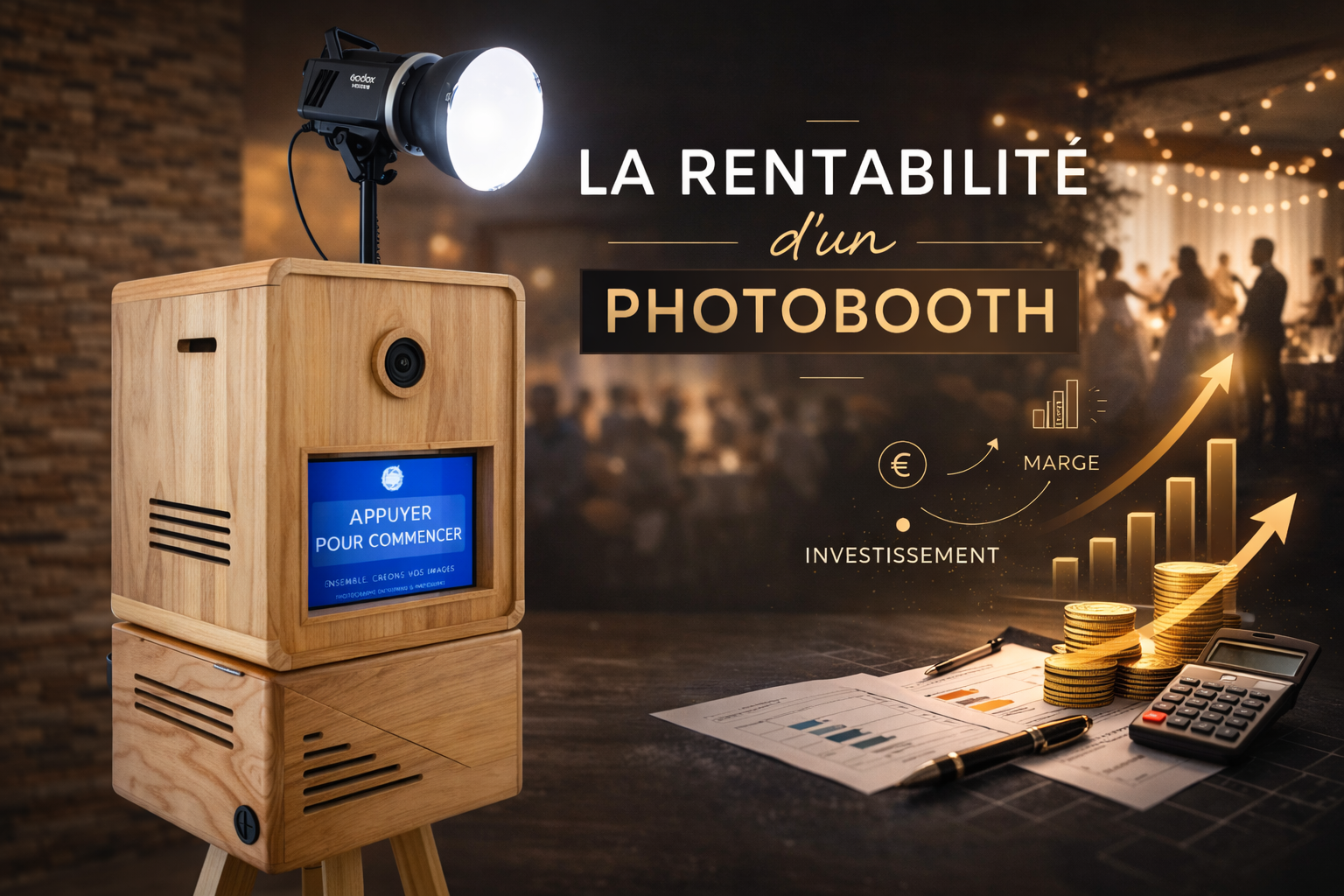
We often hear people say , “A photo booth pays for itself.” That’s sometimes true… but it depends on a lot of factors.
The profitability of a photo booth is like that of a good restaurant: it’s not just about having a “good product.” It’s also about frequency, visibility, average price, and perceived quality. The photo booth is a tool. What makes the difference is your ability to rent it out regularly, market it effectively, and build a reputation.
Here, we’ll start by laying out the basics, then walk you through a realistic example using your rates, and finally share the most effective strategies for accelerating profitability.
1) What is the return on investment for renting a photo booth?
The first (and most common) mistake is to confuse revenue with profit.
When you charge €420 (including tax) for a rental, you don’t actually pocket “€420 in profit.” You have to deduct at least:
consumables (paper and ribbon),
travel expenses (fuel + time + wear and tear),
and, above all,the equipment costs that need to be recouped (photo booth + printer).
Here’s the good news: with a properly set-up photo booth, supplies are rarely the real issue. The real question is:
“Am I visible enough to land a steady stream of gigs?”
And right after that:
“Do my photo quality and equipment justify charging professional rates?”
Because a profitable photo booth is almost always one that checks both of these boxes:
It 's available for rent (visibility + trust)
It's pricey (quality + experience + design + reliability)
2) The key: being visible and well-known (marketing & communication)
A photo booth isn’t something you buy “on a whim.” It’s an event service: above all, the customer is buying the assurance of peace of mind. They ask themselves some very simple questions:
“Will the photos turn out well?”
“Is it worth it?”
“Does this look professional?”
“If something goes wrong, will someone be there to help me?”
And that’s where a crucial point comes in: your photos are your advertising.
Great photos sell for you
An “average” photo will do the job… but it won’t create a “wow” effect.
A “premium” photo—bright, flattering, well-framed, and well-printed—will:
Stories,
sharing,
recommendations,
"organic" requests (without advertising) -> you're guaranteed to win
In other words:photo quality isn't just a technical detail—it's a direct marketing tool.
That’s why quality is in Bizbooth’s DNA: photo quality, design quality, lighting quality—and quality, period! And when we say quality, we also mean high-quality communication tools, which is why the PRO PREMIUM Pack includes professional images you can use for all your marketing to attract as many customers as possible. Learn more here:
Link: Discover the Pro Premium Pack
Design matters more than we think
Another factor that significantly impacts profitability is perceived value. A stylish, high-end photo booth that “makes a statement” inspires more confidence and allows you to charge professional rates. Conversely, a photo booth that looks like a gimmick drives prices down and forces you to handle a higher volume of business to earn the same amount.
In this industry, moving upmarket isn't a luxury—it's often the most profitable strategy.
3) Standard profitability analysis
Basic data (average price)
DNP DS620 consumables: ≈ €50 (excl. tax) for 400 prints
→ or ≈ €0.125 (excl. tax) per print (approx. 12 cents excl. tax)Average prices (your rates):
400 prints: €420 (including tax)
200 prints: €330 (including tax)
100 prints: €270 (including tax)
Travel expenses: €0.50/km (50 cents/km) or a flat rate of €50 depending on the zone
Benchmark investment:
Bizbooth PRO Package: €4,100 (excluding tax)
DNP DS620 / Citizen CX-02 printer: ≈ €1,000 (excl. tax)
→ Total investment: ≈ €5,100 (excl. tax)
Note: To be precise, we often refer to pre-tax figures when discussing “profitability,” since VAT is not considered profit. However, to keep things simple, we’ll mainly focus on “actual margin” and orders of magnitude. You can adjust these figures to fit your specific situation, but our calculations provide a general idea.
Example scenario: a second-year property owner renting only on weekends, with 22 rentals
In our example, here is the number of rentals made:
10 rentals of 400 prints
8 rentals of 200 prints each
4 rentals of 100 prints each
Annual revenue (including tax)
10 × 420 = €4,200
8 × 330 = €2,640
4 × 270 = €1,080
Total gross revenue = €7,920 incl. tax (for the year)
Annual supplies (excl. tax)
Total number of prints:
10 × 400 = 4,000
8 × 200 = 1,600
4 × 100 = 400,
. Total = 6,000 prints
Cost of supplies:
6,000 × €0.125 (excl. tax) ≈ €750 (excl. tax)
This figure is significant because it debunks a common misconception: consumables don’t “eat into” your profit margin, even with a high volume of prints. Of course, this calculation doesn’t account for waste, and there will always be some, but it remains very reasonable (though not negligible—we’ll get to that later).
What you actually get from a service
Without getting bogged down in formulas, keep this in mind (as a rough guide):
A job of 400 prints costs €420 including tax and uses approximately €50 (excluding tax) worth of paper and ribbon.
The cost of paper is only a small part of the total price. The rest covers your equipment depreciation, your time, and your profit margin.A print run of 200 copies costs about €25 (excluding tax) in supplies: again, this is a small amount compared to the price charged.
A package of 100 prints costs about €12.50 (excluding tax): that’s clearly not where profitability comes into play.
The real factor: travel (and it needs to be managed)
Travel expenses can eat into your profits if you don’t bill for them properly.
Two sound approaches (the ones you suggest):
€0.50/km: simple, fair, scalable
€50 package: very clear for the customer
A concrete example:
If an event is a 60-kilometer round trip, at €0.50 per kilometer → €30 × 2 round trips = €60. That’s the fair price.
If you use a flat rate → €50. For 60 km, you lose €10 but it makes the math easier. Sometimes customers lose out, sometimes they come out ahead.
Be sure to keep in mind that there are two round trips. Carefully calculate the maximum distance you’re willing to travel and what’s cost-effective based on your experience.
👉 Conclusion: Travel expenses must be properly tracked and billed; otherwise, you may end up “working hard” for mediocre results.
How many rentals does it take to recoup the investment?
The standard price for this professional-grade system is around €5,100 (excluding tax) (package + printer).
In a scenario involving 22 rentals, the payback period is generally around 20 to 24 rentals, depending on:
your share of “400 prints” (more profitable),
your travel expenses,
the options you've sold (guest book, backdrop, video, etc.).
your taxes and VAT (which are not included in our calculations because they depend on your status)
And that’s where it gets interesting: once the investment has been recouped, each event generates a significantly higher profit margin, because the investment is already behind you. This calculation can also be viewed from a different angle, using a 3- or 5-year payback period, but I’ll leave that for you to discuss with your accountant or during one of the coaching sessions included in the Pro Premium package.
4) Tips for becoming profitable faster (the factors that make all the difference)
1) Move upmarket instead of lowering your prices
The “I’m cheaper than everyone else” strategy rarely works for long. It attracts customers who haggle over every penny, and forces you to take on a huge number of gigs just to make a decent living.
On the other hand, a premium photo booth helps you :
charge more,
get more recommendations,
be taken more seriously (premium weddings, corporate events, upscale venues).
And specifically, what sets it apart from the rest:
image quality (well-controlled flash, flattering results),
stability (no bugs, no stress),
design (elegant, cohesive, “a thing of beauty”),
customer experience (simple, fast, reassuring).
That’s exactly what Bizbooth is all about: a photo booth that serves as both a service tool and a marketing tool.
2) Optimize consumables without compromising the experience
Yes, the cost of supplies isn't everything, but over the course of a season, optimization matters—as we mentioned earlier in the article:
buy in bulk (often starting at 5 boxes, the unit cost is more competitive),
Avoid opening a new roll of paper for a small event: if you’re on-site, use up the remaining paper and change the rolls regularly—it’s more eco-friendly, and instead of throwing it away, you’ll save money.
Be a great supplies manager: keep track of your paper and ribbon rolls based on upcoming events, make a chart, note what you have left, and don’t let anything go to waste.
With good planning, you might even be able to cover three events with a single roll of 400 prints! We’ll talk about this in coaching;)
3) Turn every event into an opportunity for publicity
A profitable photo booth is one that generates the following:
To set up:
business card displayed near the photo booth,
QR code to your social media / gallery,
requesting a Google review after the service,
publication of the best photos (with permission) and staged shots.
The difference between an “average” rental company and a “highly profitable” one often lies here: the latter treats every date as a marketing opportunity.
4) Boost sales during the off-season
To dampen the signal quickly, it’s often a good idea to add filters:
school fairs, schools, snack time (pay-per-photo system),
Christmas markets, community events,
bars, public places, regular events,
Business events: cocktail parties, grand openings, seminars.
5) Focus on partnerships (the best approach)
Partnerships are the fast track to profitability:
event agencies,
reception venues,
bars / concert venues,
vendors (DJs, photographers, wedding planners),
local businesses.
A single strong partnership can mean 5 to 15 events a year. And that’s when your profitability takes off—especially when you expand to renting out 2 or 3 photo booths, you’ll be able to earn a solid annual income.
Conclusion: A profitable photo booth is a well-organized business
A photo booth can be highly profitable, especially with a professional approach and a clear strategy. With well-managed pricing and consumable costs, the business can realistically break even after about 20 to 24 rentals, and then generate a much more comfortable profit margin in subsequent seasons.
The key isn't "saving paper." The key is:
to be visible,
inspire confidence,
deliver premium quality,
and become a key player in your area.
For more information, Bizbooth offers a “pro-to-pro” ebook designed to help you organize your business (pricing, common pitfalls, sales scripts, strategy, partnerships, etc.)